
IP Protection Record
● Definition and Scope of Customs Protection of Intellectual Property Rights
Customs protection of intellectual property rights refers to the protection exercised by the customs over trademark rights, patent rights, copyrights, and related rights that are related to import and export goods (excluding transit, through, and transshipment goods) and protected by the laws and administrative regulations of the People's Republic of China.
Only intellectual property rights protected under Chinese law can apply for customs protection registration, as follows:
Trademark: Registered with the China Trademark Office, or registered with the World Intellectual Property Organization with its validity extending to China;
Patent: Granted a patent by the China National Intellectual Property Administration.
Copyright: Copyright and related rights owned by citizens or entities of members of the Berne Convention for the Protection of Literary and Artistic Works and the Agreement on Trade-Related Aspects of Intellectual Property Rights (TRIPS).
● Who can apply for registration?
Intellectual property rights holders, acting as applicants, apply to customs for intellectual property registration. Here, "intellectual property rights holders" refers to trademark registrants, patent holders, copyright holders, and related rights holders as defined in China's Trademark Law, Patent Law, and Copyright Law . Rights holders may appoint agents to handle the application; however, overseas rights holders must appoint agents in China . For jointly owned intellectual property, if any one rights holder has already submitted a registration application to the General Administration of Customs, other rights holders do not need to submit an application. If there are joint rights holders, proof of joint rights is required; if this is not possible, it is recommended to add them as legal users.
● What can we do for you?
(1) When applying for filing with the General Administration of Customs on behalf of domestic and foreign rights holders, it should be noted that foreign rights holders must entrust Chinese agents to apply, which is a mandatory requirement.
(2) Act as an agent for domestic and foreign rights holders to apply for their trademarks or patents in China and obtain the Trademark Registration Certificate or Patent Certificate issued by the Chinese administrative authorities .
(3) Continuously update the validity of intellectual property and customs filing information to save enterprises effort.
(4) Help enterprises explain protection inquiries or questions to customs.
(5) Helps to overcome language barriers and differences in understanding , avoid misjudgment, and improve the accuracy and efficiency of customs protection.
(6) The agent applies for intellectual property rights in the target market to better protect its own legitimate rights .
(7) Other matters related to intellectual property rights.


● Filing process
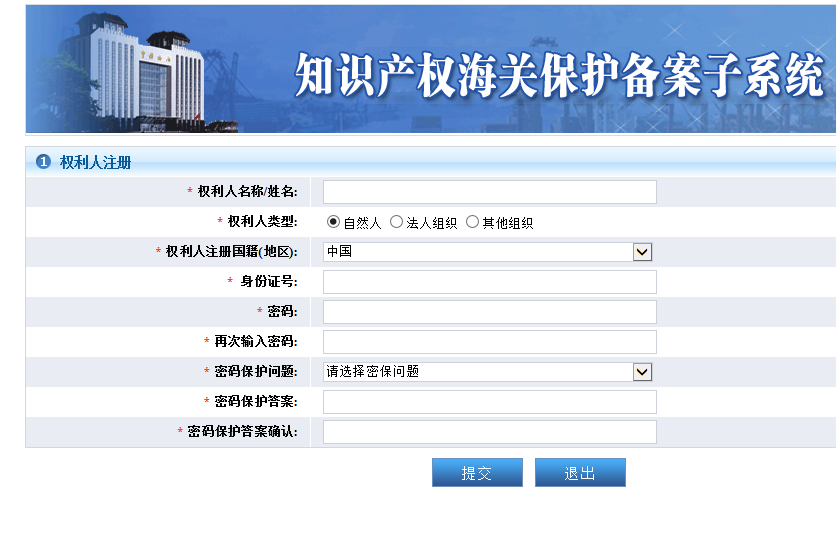
Step 1: Log in to the system and register a user
Upon entering the intellectual property registration system, the intellectual property rights holder or their agent registers in the name of the intellectual property rights holder, fills in user information, and submits it for review.
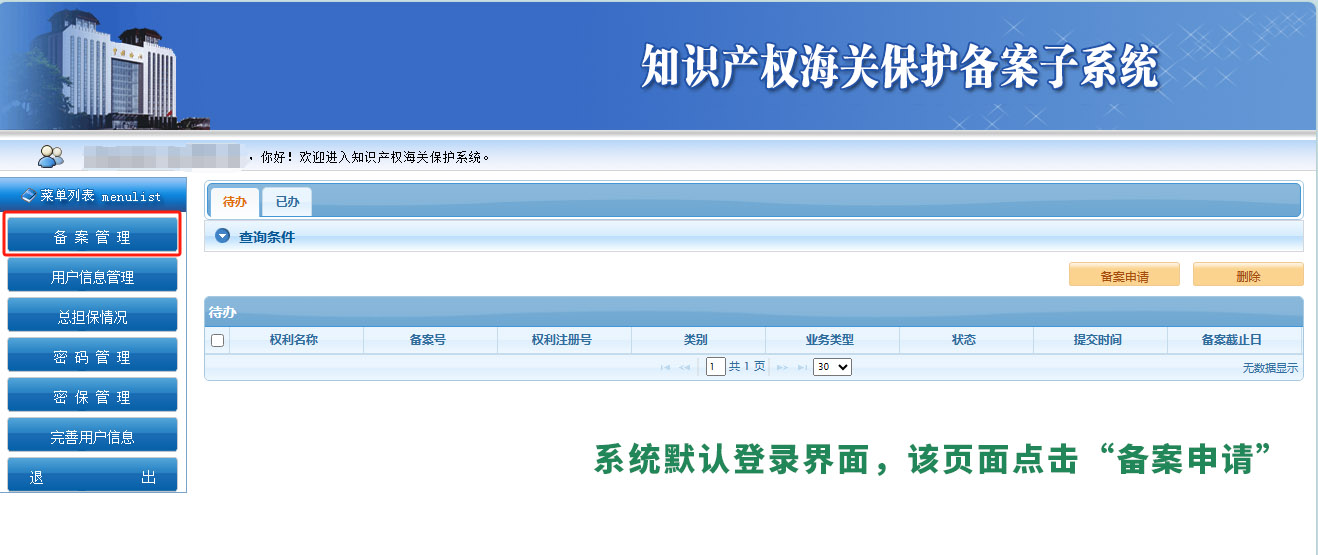
Step 2: Apply for intellectual property registration
Fill in and submit the intellectual property rights and related information for the new filing application in the application window.
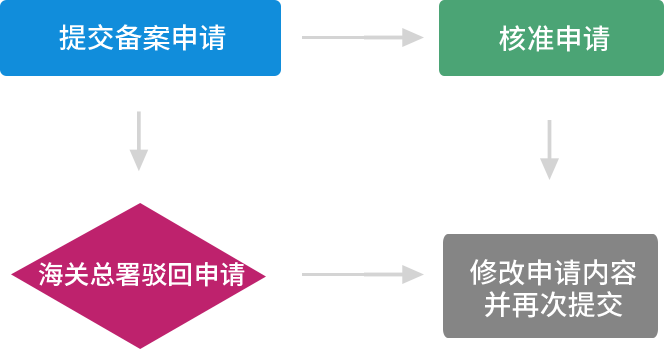
Step 3: Receiving notification of whether the application is approved or rejected.
The General Administration of Customs will make a decision to approve or reject the application within 30 working days from the date the applicant submits the filing application. If the General Administration of Customs rejects the application, the rights holder may revise the application based on the reasons for rejection and resubmit it.
● Application should include the following:
(1) The name of the intellectual property rights holder, place of registration or nationality, mailing address, contact person's name, telephone and fax numbers, email address, etc.
(2) The name of the registered trademark, the category and name of the goods approved for use, the trademark graphic, the registration validity period, and the transfer, modification, and renewal of the registered trademark; the name of the work, the time of completion of creation, the category of the work, the image of the work, and the transfer and modification of the work; the name, type, and application date of the patent right, and the transfer and modification of the patent right.
(3) The name of the licensee, the goods licensed, the license term, etc.
(4) The name, place of origin, customs at the port of entry and exit, importer and exporter, main characteristics, price, etc. of the goods for which the intellectual property rights holder lawfully exercises intellectual property rights.
(5) Manufacturers, importers and exporters, customs at the port of entry and exit, main characteristics, prices, etc. of known infringing intellectual property rights goods.
Intellectual property rights holders shall submit a separate application for each intellectual property right they wish to register. Intellectual property rights holders applying for international trademark registration shall submit a separate application for each class of goods for which they are applying.
● The following documents and evidence should be attached:
(1) Identification documents of the intellectual property rights holder.
(2) A photocopy of the Trademark Registration Certificate issued by the State Administration for Industry and Commerce. If the applicant has been approved to change trademark registration items, renew trademark registration, transfer a registered trademark, or apply for international trademark registration filing, they shall also submit relevant trademark registration certificates issued by the State Administration for Industry and Commerce; a photocopy of the voluntary copyright registration certificate issued by the copyright registration department and photographs of the work certified by the copyright registration department. If the applicant has not voluntarily registered copyright, they shall submit samples of the work that prove the applicant is the copyright holder and other relevant copyright evidence; a photocopy of the patent certificate issued by the State Patent Administration Department. If the patent authorization has been granted for more than one year from the date of publication, a copy of the patent register issued by the State Patent Administration Department within six months before the applicant submits the filing application shall also be submitted; if applying for utility model patent or design patent filing, a patent evaluation report made by the State Patent Administration Department shall also be submitted.
(3) If the intellectual property rights holder licenses others to use a registered trademark, work or implement a patent and a license agreement is signed, a copy of the license agreement shall be provided; if no license agreement is signed, a written explanation of the licensee, the scope of the license and the license period shall be submitted.
(4) Photographs of goods and their packaging in which the intellectual property rights holder lawfully exercises intellectual property rights.
(5) Evidence of known import and export of infringing goods. If the infringement dispute between the intellectual property rights holder and another party has been handled by a people's court or intellectual property authority, copies of the relevant legal documents shall also be submitted.
The documents and evidence submitted by the intellectual property rights holder to the General Administration of Customs in accordance with the preceding paragraph shall be complete, authentic, and valid. If the documents and evidence are in a foreign language, a Chinese translation shall be attached. The General Administration of Customs may, when it deems necessary, require the intellectual property rights holder to submit notarized or authenticated documents or evidence.
● Material Requirements:
(i) Application for customs protection of intellectual property rights (if the original or supporting document is a photocopy, the rights holder/agent must sign "verified as true to the original" and affix a color seal, and then upload a color scan and one electronic copy of the photocopy).
1. Trademark filing application: Trademark registration certificate issued by the national trademark administration department.
2. Patent filing application: Patent certificate issued by the national patent administration department, copy of the patent register, utility model search/patent evaluation report, patent announcement drawings, and other supporting documents.
3. Copyright registration application: Copyright registration certificate issued by the national or provincial copyright registration department, photograph of the work stamped with the seal of the copyright registration department, and other copyright evidence.
(ii) Renewal of Customs Protection Filing for Intellectual Property Rights (If the original or supporting document is a photocopy, the rights holder/agent must sign "verified as true to the original" and affix a color seal, and then upload a color scan of the photocopy and one electronic copy).
1. Trademark Renewal: A trademark renewal certificate issued by the national trademark administration department.
2. Patent renewal: A receipt issued by the national patent administration department proving payment of the annual fee.
(iii) Cancellation of Customs Protection Filing for Intellectual Property Rights (If the original or supporting document is a photocopy, the rights holder/agent must sign "verified as true to the original" and affix a color seal, and then upload a color scan and one electronic copy of the photocopy). Trademark Cancellation: Submit a cancellation application.
(iv) Cancellation of filing (original documents, paper materials, two copies)
1. An application to withdraw a filing must clearly identify the applicant and the respondent, the application matter, and the basic facts and reasons.
2. Relevant evidence and explanatory materials (such as trademark rulings issued by the State Trademark Administration).
3. If the applicant entrusts another party to handle the matter, a power of attorney for the application to revoke the customs protection filing for intellectual property rights shall be submitted.
4. Identification documents of the applicant and their agent.
5. Explanation of interests and consequences.
6. Other materials required as evidence.
● Notice:
•overseas must be registered with the State Trademark Administration of China and then filed with the Customs Intellectual Property Filing System, along with a copy of the Trademark Registration Certificate issued by the State Administration for Industry and Commerce.
•overseas intellectual property rights holders file for registration, they should entrust a domestic agent to submit the application and provide a power of attorney in the prescribed format. The power of attorney template can be downloaded from the Intellectual Property Customs Protection System.
•Trademark filing does not currently recognize the "Trademark File Certificate," only the "Trademark Registration Certificate."
● Advantages of Customs Registration for Intellectual Property Rights
• Protecting intellectual property rights ex officio: Customs protection filing is a prerequisite for customs to take proactive protection measures.
Only when the intellectual property rights have been registered with the General Administration of Customs will the Customs proactively notify the intellectual property rights holder of suspected infringing goods and suspend their import and export. After the rights holder submits an application to the Customs for the detention of goods and provides a guarantee, the Customs will, in accordance with the law, detain the goods, conduct an investigation, and make an administrative decision in accordance with the law—intellectual property protection measures. If the Customs determines that there is infringement, it will confiscate the infringing goods and impose a fine in accordance with the law. If a crime is suspected, the case will be transferred to the public security organs for criminal prosecution in accordance with the law.
• It helps customs to detect infringing goods in a timely manner.
When applying for registration, intellectual property rights holders need to provide information such as the legal status of the intellectual property, their contact information, the legal use of the intellectual property, and details of suspected infringing goods. This information helps customs to identify and proactively detain suspected infringing goods during routine supervision, ensuring timely protection of the rights holder's legitimate rights. Furthermore, the information on the legal use of intellectual property in the registration helps licensed goods clear customs quickly.
• The cost of protecting rights is relatively low, and the economic burden on rights holders is relatively light.
Under the customs' ex officio protection model, the maximum guarantee that an intellectual property rights holder can provide to the customs is RMB 100,000. However, if the intellectual property rights holder has not registered the intellectual property rights in advance, they cannot enjoy the above-mentioned treatment and must provide a guarantee of equal value to the goods they request to be detained. Therefore, proactively registering the intellectual property rights greatly reduces the rights holder's cost of protecting their rights and alleviates their economic burden.
• Prevention of infringement
Registering intellectual property rights under customs protection can deter infringers. Since customs has the power to confiscate infringing goods and impose administrative penalties on importing and exporting companies, early registration can serve as a warning and deterrent to companies that have previously brazenly imported and exported infringing goods, prompting them to consciously comply with relevant intellectual property laws and regulations and avoid or mitigate damages suffered by rights holders.
• Facilitate the initiation of other relief measures
Evidence collected by customs when it uncovers infringement is recognized by the people's courts or other intellectual property administrative authorities. This facilitates the rights holder's ability to take further legal action, thereby enabling the more rapid and accurate handling of infringement disputes and providing convenience for initiating civil remedies.
• Maintaining normal import and export trade order
To combat the import and export of infringing goods and maintain normal import and export trade order ; to prevent counterfeit and infringing goods from entering the international market and enhance the international image of Chinese products ; and to improve China's intellectual property protection system and improve the domestic investment environment.
● In short, the customs' proactive protection model based on its authority:
• Prerequisite: Registration with the General Administration of Customs
• Initiating entity—Customs proactively initiates the process
• Guarantee deposit – up to CNY 100000
• After detention—Customs will proactively investigate, review, and enforce penalties.
● Penalties that companies infringe on intellectual property rights
01 Administrative Responsibility
If the detained goods suspected of infringement are determined by customs investigation to constitute infringement, the customs shall confiscate them and impose a fine of up to 30% of the value of the goods on the importing and exporting enterprises.
02 Criminal Liability
If the import or export of goods infringing intellectual property rights meets the criteria for criminal prosecution, the customs will transfer the case to the public security department for investigation and prosecution in accordance with the law.
03 Civil Liability
Intellectual property rights holders may also file lawsuits in the People's Court against import and export enterprises for importing and exporting infringing goods, demanding that they bear civil liability for infringement.
04 Credit Punishment
Adhering to the principle of "facilitating compliance and punishing violations," the Customs has integrated intellectual property administrative penalties with enterprise credit management. In accordance with the "Measures of the Customs of the People's Republic of China for Enterprise Credit Management," the Customs will lower the credit rating of enterprises that infringe intellectual property rights by importing or exporting goods, and will implement joint penalties.
1. Maintenance
Relevant enterprises and rights holders should promptly maintain their registration information, including company contact information, intellectual property rights information, and information on legal users. This can help customs eliminate suspicions of infringement in imported and exported goods and ensure the smooth clearance of legally authorized products. When registered intellectual property rights change, timely procedures for registration modification or cancellation should be completed to avoid compensation claims from consignors and consignees of imported and exported goods due to invalid registration.
2. Timely communication
Relevant enterprises and rights holders should actively collect information on infringing goods and promptly report it to the customs, and maintain close contact with the customs in the enterprise's location.
3. Actively cooperate
Relevant enterprises and rights holders should actively cooperate with customs in carrying out intellectual property protection enforcement actions. This includes promptly confirming the infringement status of goods within the specified time limit and actively cooperating with customs in intellectual property status investigations.
● Regarding the validity period, renewal, modification, and cancellation of filing records.
• Validity period and renewal of the filing
The registration of intellectual property rights under customs protection takes effect from the date of approval by the General Administration of Customs and is valid for 10 years. If the validity period of the intellectual property rights is less than 10 years after the approval of the registration by the General Administration of Customs, the validity period of the registration shall be based on the validity period of the intellectual property rights; if it exceeds 10 years, the maximum validity period of the registration shall be 10 years.
Provided the intellectual property rights are valid, the intellectual property rights holder may submit a written application for renewal of the registration to the General Administration of Customs within six months before the expiration of the registration period, along with relevant documents. The validity period of the renewed registration shall be calculated from the day following the expiration of the previous registration period and shall be 10 years. If the validity period of the intellectual property rights is less than 10 years from the day following the expiration of the previous registration period, the validity period of the renewed registration shall be based on the validity period of the intellectual property rights.
• What if I forget to apply for renewal?
If you do not submit a written application for renewal of your registration to the General Administration of Customs within 6 months before the expiration date, the "registration status" of the relevant intellectual property rights will change from "valid" to "invalid" on the day after the expiration date, and the customs nationwide will be unable to protect the intellectual property rights you have registered.
• Changes and cancellations of registration
According to regulations, if the intellectual property rights registered under customs protection are altered after approval by the General Administration of Customs, the intellectual property rights holder shall, within 30 working days from the date of the alteration, complete the registration change or cancellation procedures with the General Administration of Customs and attach relevant documents. If the intellectual property rights holder fails to complete the change or cancellation procedures as stipulated in the preceding paragraph, causing serious impact on the legitimate import and export of others or the lawful performance of customs supervision duties, the General Administration of Customs may revoke the relevant registration upon application by relevant interested parties, or may revoke the relevant registration on its own initiative.
1. What is customs filing for intellectual property rights?
A: Customs filing for intellectual property rights refers to the procedure by which intellectual property rights holders apply to the General Administration of Customs of China for filing information on the intellectual property rights they wish to protect in order to obtain customs protection.
2. What does intellectual property include?
(1) Patent rights: invention, utility model, and design;
(2) Trademark rights: trademarks for goods and services (marks for products and services);
(3) Copyright: Copyright and related rights, including: copyright of computer software;
3. What are the benefits of filing for customs protection of intellectual property rights?
A: First, registration is a prerequisite for customs to take protective measures ex officio. Customs only investigates and handles goods suspected of infringing intellectual property rights registered with the General Administration of Customs. Second, it helps customs promptly identify suspected infringing goods during routine supervision. Third, it reduces the occurrence of infringement. Making the relevant registration information public can serve as a warning and deterrent to companies importing and exporting infringing goods, and also provides companies engaged in OEM manufacturing with a way to check their intellectual property status, thus preventing infringement.
4. Who can apply for customs protection filing for intellectual property rights?
A: Only intellectual property rights holders can apply. Domestic intellectual property rights holders can submit applications directly or through their domestic agents, while overseas intellectual property rights holders must submit applications through their domestic agents.
5. How to apply for customs protection filing for intellectual property rights?
A: To apply for customs protection filing for intellectual property rights, you should first log in to the official website of the General Administration of Customs—"Internet + Customs"—"I Want to Apply"—Intellectual Property Protection Filing, and then follow the steps below:
(1) Register as a system user in the name of the intellectual property rights holder.
(2) Fill in and submit the intellectual property rights and other relevant information for filing in the new filing window.
(3) The General Administration of Customs will make a decision to approve or reject the application within 30 working days. The right holder may modify the application content and resubmit it based on the reasons for rejection.
6. How long does it take to review and approve customs protection filings for intellectual property rights?
A: The General Administration of Customs will make a decision to approve or reject the application within 30 working days from the date the applicant submits the filing application.
7. What is the validity period of the customs protection filing for intellectual property rights? What happens after it expires?
A: The customs protection filing for intellectual property rights takes effect from the date of approval by the General Administration of Customs and is valid for 10 years. Intellectual property rights holders may apply to the General Administration of Customs for renewal of the filing within 6 months before the expiration date.
8. What will customs do if it discovers that imported or exported goods infringe upon registered intellectual property rights? What is the rights holder required to do?
A: If Customs discovers imported or exported goods suspected of infringing on registered intellectual property rights, it will suspend customs clearance and notify the rights holder in writing. The rights holder should submit a written application to Customs for the detention of the suspected infringing goods and provide the required security within 3 working days from the date of service of the notification. If the rights holder informs in writing that the goods do not infringe on intellectual property rights or fails to respond within the prescribed time limit, Customs will continue to process other customs formalities in accordance with the law.
9. What conclusions will the customs make when investigating infringing goods?
A: After investigation, Customs may make one of three decisions: "infringement determined," "no infringement determined," or "cannot be determined." If infringement is determined, administrative penalties will be imposed; if no infringement is determined, the goods will be released. If the determination cannot be made, the rights holder will be notified in writing immediately.
10. How does customs handle confiscated and infringing goods?
A: According to Article 27, Paragraph 3 of the "Regulations of the People's Republic of China on Customs Protection of Intellectual Property Rights":
(1) If the confiscated goods infringing intellectual property rights can be used for public welfare purposes, the customs shall transfer them to the relevant public welfare organizations for public welfare purposes.
(2) If the intellectual property rights holder has the intention to acquire the property, the customs may transfer it to the intellectual property rights holder for consideration;
(3) If the confiscated infringing intellectual property goods cannot be used for public welfare and the intellectual property rights holder has no intention to purchase them, the customs may auction them in accordance with the law after eliminating the infringing features. However, for imported counterfeit trademark goods, except in special circumstances, the customs may not allow them to enter the commercial channel simply by removing the trademark markings on the goods.
(4) If the infringing features cannot be eliminated, the customs shall destroy them.
11. What is the significance of customs protection of intellectual property rights?
A: On a macro level , it helps maintain normal import and export trade order, enhances the international image of Chinese products, improves China's intellectual property protection system, and improves the domestic investment environment. On a micro level , it can stop ongoing infringements , prevent future infringements , and facilitate the initiation of civil remedies.
12. Are foreign rights holders required to appoint a Chinese agent?
A: Yes, it is mandatory to appoint an agent. According to customs regulations, rights holders outside mainland China (whether individuals or companies) must appoint an institution or individual within China as their agent when handling matters related to customs protection of intellectual property rights.
13. Can the licensee be added simultaneously during the filing process?
A: Yes, it's very convenient. There's no need to wait until the registration is complete before taking any further steps. The process for applying for a new customs registration includes a step to "add legal user information." You can manually add the licensee's (such as authorized manufacturers or distributors) information into the system in batches by "adding manually" or "importing locally" from an Excel file. You will need to provide the licensee's name, type, licensed goods, and license period.
14. Can foreign rights holders log into their accounts? What permissions do they have?
A: Yes, you can log in. You can manage agents. You can maintain licensees, adding, deleting, or updating information about "legal users" (i.e., licensees) at any time, which is very friendly to business models with short-term licenses and frequent changes of manufacturers. You can maintain monitored products, adding or updating information such as photos and infringement characteristics of products that you want customs to focus on. You can submit renewal applications. You can submit proof of patent annuity payment. You can manage account information, such as changing your company's contact information, phone number, email address, and login password.
15. Can a foreign rights holder change their agent?
A: Yes. First, log in to the rights holder's account and go to the menu. In the left-hand function area, select "User Information Management - User Management". To initiate a change, click the "Change Agent" option. Fill in the information as prompted on the page, including the new agent's details, and upload the new power of attorney, company identification documents, etc. Submit for review and wait for the General Administration of Customs' approval result. However, please note that once the change agent application is approved, for security reasons, the system will automatically reset the login password and send the new password to the new agent's email address. At this point, the new agent can use the new password to take over subsequent operations, and the original agent will automatically lose their privileges.
